
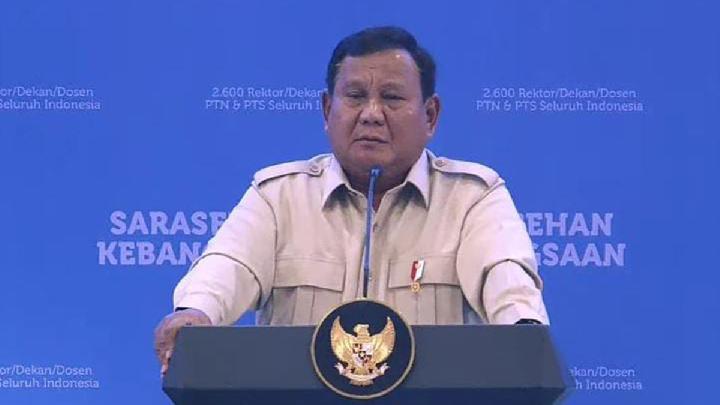
TEMPO.CO, Jakarta - President Prabowo Subianto, alongside the Ministry of Energy and Mineral Resources, has officially launched the 100 GW Solar Power Plant Program and Battery Energy Storage System (BESS). The rollout on Tuesday, August 25, 2026, also marked the groundbreaking of state utility PLN’s 305 MWp solar power facility and 1 GWh BESS in Gilimanuk, Bali.
The government stated that the 100-gigawatt solar initiative will encompass diesel replacement, rural and productive village electrification, grid reinforcement, and dedicated power supply for industrial zones. Authorities also pledged to integrate BESS technology to foster a cleaner, more reliable, and sustainable power grid.
According to Energy and Mineral Resources Minister Bahlil Lahadalia, developing the 100-gigawatt solar program requires an estimated US$73 billion in investment and holds the potential to generate roughly 5.52 million jobs. Furthermore, the resulting savings in energy subsidies are projected to reach around Rp73.9 trillion annually.
The Institute for Essential Services Reform (IESR) agrees that expanding solar power and storage capacity is vital for bolstering energy resilience, maximizing domestic renewables, and curbing Indonesia's reliance on fossil fuels and off-grid power generation.
"Combining solar power with BESS can also boost the reliability of Bali's power grid by supplying local clean energy and providing the flexibility needed to manage solar intermittency," IESR Chief Executive Officer Fabby Tumiwa said in a statement on Wednesday, August 26, 2026.
Analysts also noted the strategic importance of selecting Bali as the launch site for the initiative. The island province has committed to the Bali Net Zero Emission 2045 vision, an initiative spearheaded by the Bali Provincial Government alongside IESR and key stakeholders since 2023. IESR believes central government and PLN backing through solar and storage investments will accelerate Bali's drive toward energy independence and net-zero emissions ahead of the national target.
For this reason, Fabby stressed that the program’s launch and initial groundbreaking must signal the start of a far broader execution phase. He emphasized that the true success of the 100 GW initiative hinges not on how many projects break ground, but on how many gigawatts of solar capacity are constructed, grid-connected, and reliably generating power before 2029.
"The central challenge now is turning the President's political commitment into an operational machine capable of building tens of gigawatts of solar power each year," Tumiwa added.
According to IESR, achieving 100 gigawatts in under four years is an immensely ambitious undertaking that demands innovative execution strategies. To succeed, Fabby added, the initiative requires a robust, consistent, and legally sound national execution framework.
"The government must quickly establish dedicated leadership empowered to coordinate across ministries, PLN, regional authorities, industry players, financial institutions, and private enterprises," he said.
To that end, IESR recommends six priority measures to ensure the program meets its 2029 milestone. First, according to Fabby, the government must swiftly finalize a Presidential Regulation (Perpres) to serve as the legal foundation for the 100 GW solar initiative. The regulation ought to clearly define targets, roles and responsibilities, coordination protocols, financing avenues, procurement rules, and governance principles centered on transparency and accountability.
Authorities also need to update the National General Energy Plan (RUEN) and PLN’s Electricity Supply Business Plan (RUPTL) to fully incorporate the additional 100 GW solar quota. "Furthermore, the government should designate this initiative as a National Strategic Project (PSN) to streamline permitting, land acquisition, grid expansion, and cross-sectoral hurdles."
Second, Fabby called for the immediate drafting of a clear annual project pipeline running through 2029. This entails a detailed roadmap outlining project locations, capacity targets, procurement timelines, grid infrastructure, and BESS requirements, enabling investors and industrial players to commit capital with confidence.
Third, the government should accelerate procurement through competitive, transparent, and bankable tender processes that secure affordable power tariffs while drawing substantial private investment. Fourth, officials must ensure power grid readiness by expanding transmission and distribution networks, digitalizing infrastructure, deploying additional BESS units, boosting operational flexibility, and expanding rooftop solar quotas.
Fifth, Indonesia needs to build a domestic supply chain supported by pragmatic, phased, and market-competitive local content rules, ensuring industrial development does not compromise cost efficiency or deployment speed.
Sixth, the country should adopt a multi-track execution strategy so that reaching the 100 GW milestone does not rely exclusively on PLN-led developments. "The government must empower regional authorities, cooperatives, local communities, commercial sectors, rooftop solar developers, and independent power producers to accelerate overall capacity expansion."
Read: How Indonesia Plans to Fund the 100 GWp Solar Project
Click here to get the latest news updates from Tempo on Google News


































:strip_icc():format(jpeg):watermark(kly-media-production/assets/images/watermarks/bola/watermark-color-landscape-new.png,1125,20,0)/kly-media-production/medias/5215189/original/094397100_1746795977-20250509AA_Persija_Jakarta_vs_Bali_United-8.jpg)