
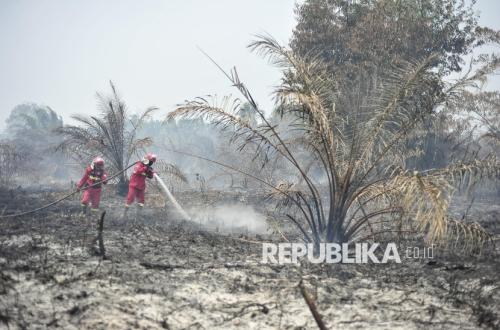
TEMPO.CO, Jakarta - The Ministry of Health has drafted a circular to mitigate the impact of smoke from forest and land fires on children's health. Schools in regions with poor air quality are advised to scale back in-person classes and switch to distance learning (PJJ).
The Ministry of Health's Director of Environmental Health, Then Suyanti, said the circular will be sent by the ministry's Secretary General to the Ministry of Education and Culture and the Ministry of Religious Affairs. "If the Air Pollution Standard Index (ISPU) registers high and unhealthy levels, schools can suspend outdoor activities and shift to distance learning," Then said during a virtual press conference on Wednesday, August 26, 2026.
According to Then, the circular is currently being finalized and is expected to be issued within two days. The policy primarily aims to safeguard vulnerable groups, particularly children, from exposure to fire-generated pollutants. The Health Ministry also urged local governments to monitor air quality as a guide for regulating community activities, including school operations.
Previously, the Ministry of Environment and Forestry issued a circular instructing governors, regents, and mayors to track air quality across their respective jurisdictions. "Schools in affected areas are advised not to conduct in-person classes as ISPU levels rise," Then said.
The Health Ministry noted that air quality in several regions has already reached hazardous levels. Based on monitoring data at around 5:00 a.m. on Wednesday, the ISPU in Muaro Jambi hit 302. Meanwhile, in Jekan Raya, Palangka Raya, Central Kalimantan, the index surged to 573.
An ISPU reading above 300 is classified as hazardous. The Health Ministry emphasized that such conditions pose severe health risks, advising the public, especially sensitive groups, to avoid outdoor activities.
Besides Muaro Jambi and Palangka Raya, several other regions recorded very unhealthy air quality, including Pelalawan in Riau; Penukal Abab Lematang Ilir and Ogan Ilir in South Sumatra; Southeast Pontianak in West Kalimantan; as well as Gunung Mas and Katingan in Central Kalimantan.
Then explained that haze from land fires contains fine particulate matter (PM2.5) along with carbon monoxide, nitrogen dioxide, and toxic organic compounds. Exposure to these pollutants can exacerbate acute respiratory infections, asthma, chronic obstructive pulmonary disease (COPD), and general respiratory ailments in children.
Children represent one of the groups most vulnerable to smoke exposure. According to her, children's lungs, cardiovascular systems, and cognitive functions are still actively developing.
Children also tend to spend more time playing outdoors, heightening their exposure risk. "Children are more sensitive because their lungs, cardiovascular systems, and cognitive functions are still developing, and they tend to be more active outdoors," she said.
Aside from children, groups requiring special protection include the elderly, pregnant women, individuals with asthma or COPD, and outdoor workers.
The Health Ministry also advised the public to check the ISPU before undertaking outdoor activities. As air quality deteriorates, residents are urged to limit outdoor exertion, keep doors and windows shut, and run air conditioners in recirculation mode or use air purifiers to lower indoor particulate levels.
For those required to be outdoors, the ministry recommends wearing protective masks, particularly N95 respirators. The public is also urged to seek medical attention promptly if they experience worsening health symptoms.
Head of the Health Ministry's Health Crisis Center, Agus Jamaludin, noted that local governments had previously issued various advisories to brace for the haze's impact.
The Pekanbaru Education Agency, for instance, has issued guidelines regarding school activities. "We at the Crisis Center maintain continuous coordination with city, regency, and provincial health agencies, as tackling this haze requires a layered approach," Agus said.
The Health Ministry stated that its haze response strategy involves monitoring air quality and disease trends, educating the public, and readying healthcare facilities and medical personnel.
Based on data from the Early Warning and Response System (SKDR) updated through August 22, 2026, the ministry noted an uptick in fire-related illnesses between weeks 27 and 31 of this year. Spikes were recorded in regions including West Kalimantan, Central Kalimantan, South Kalimantan, Riau, the Riau Islands, Jambi, Bangka Belitung, and West Papua.
The Ministry of Health had previously issued a preparedness circular in May 2026 to anticipate potential surges in land fires, air pollution, and climate-sensitive diseases.
Then urged the public to use air quality data when planning daily activities. "We must monitor air quality, reduce outdoor activities based on ISPU readings, wear masks when going outside, protect vulnerable groups, and seek immediate medical treatment if feeling unwell," she said.
Read: Indonesia Grants Scholarship to Viral 'Superman' Firefighter
Click here to get the latest news updates from Tempo on Google News

































:strip_icc():format(jpeg):watermark(kly-media-production/assets/images/watermarks/bola/watermark-color-landscape-new.png,1125,20,0)/kly-media-production/medias/5215189/original/094397100_1746795977-20250509AA_Persija_Jakarta_vs_Bali_United-8.jpg)