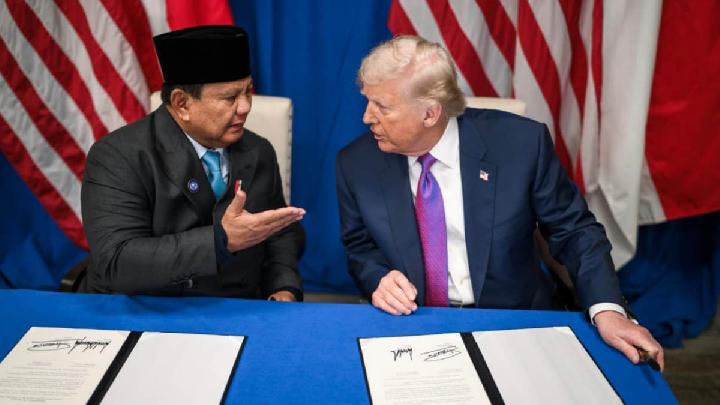
TEMPO.CO, Jakarta - Of course, U.S. President Donald Trump was delighted by the framed birth certificate of his grandfather Friedrich Trump, who was from Kallstadt, Germany, that was given to him by German Chancellor Friedrich Merz. He was also clearly flattered by the newly created FIFA Peace Prize awarded him by world soccer boss Gianni Infantino. And he was really excited about a gift from Qatar: a luxury Boeing 747-8i, worth about $400 million to be used as a potential presidential Air Force One aircraft.
However, these will likely seem insignificant in light of what María Corina Machado has in store for him on Thursday: the Venezuelan opposition leader apparently is keen to give and share with him the highly coveted Nobel Peace Prize that she won last year.
"I've heard that she wants to do that," Trump told U.S. broadcaster Fox News. "That would be a great honor," he said, adding that it was "a great shame for Norway" that the Norwegian Nobel Committee had not selected him as the Nobel Peace Prize laureate in the first place.
The committee has meanwhile issued a statement pointing out that, according to §10 of the Statutes of the Nobel Foundation, "once a Nobel Prize is announced, it cannot be revoked, shared, or transferred to others. The decision is final and stands for all time.
Maria Corina Machado was awarded the prize in December and described as a woman "who keeps the flame of democracy burning amid a growing darkness."
Snubbed and still loyal
Many, especially in Venezuela, are asking themselves: What is going on in her mind if Machado is willing to simply give away one of the world's most important awards — albeit only symbolically — to the most powerful person in the world?
Particularly after her humiliation by Trump after the U.S. removal of President Nicolas Maduro from powerin Venezuela, when he described Machado as a "very nice woman" who "doesn't have the support within or the respect within the country" and instead opted for continuity and interim president Delcy Rodríguez.
"Maria Corina Machado is undoubtedly the big loser in the Venezuelan power struggle," Renata Segura, program director for Latin America and the Caribbean at the non-governmental International Crisis Group, told DW. Many Venezuelans could no longer understand Machado's unconditional support for the Trump administration, which has now culminated in the farce surrounding the Nobel Prize, she said.
"Many in Venezuela now see her as someone who is selling out her country because she is putting her personal interests above those of Venezuela," Segura told DW. Even her supporters were disgusted that Machado has demonstratively sided with the US government and is not defending Venezuela. "For example, when Washington claimed that the vast majority of Venezuelans are bad people and come to the US with evil intentions. And also when the US bombed boats in the Caribbean and dozens of Venezuelans died, she didn't say a word."
Even before, Machado had not only made friends by repeatedly calling for military intervention by the United States to forcibly overthrow Maduro. Nor by supporting U.S. sanctions that were a means of exerting pressure on the government but under which mainly the impoverished population suffered. Nor with her recent promise to US companies of "a $1.7 trillion opportunity" in lucrative deals in the oil and natural gas sector and the mining of gold and other natural resources.
"While María Corina Machado's uncompromising struggle is truly respected in Venezuela, she is not seen as a peacemaker as she is neither dialogue-oriented nor does she build bridges," Anja Dargatz, the head of the Venezuela office of the German Friedrich Ebert Foundation, told DW. "That's why her Nobel Peace Prize was questioned a little in Venezuela," she said, adding that a local woman had told her: "It's Norway's prize, not ours."
Machado: One of many opposition figures
But Dargatz conceded that the 58-year-old, who went into hiding in Venezuela for over a year for fear of reprisals, had managed to unite the opposition ahead of the 2024 presidential elections, as well as to expose electoral fraud and forge international alliances to ensure that Venezuela did not disappear from the global agenda. Her charm offensive included a visit to Pope Leo XIV at the Vatican.
"Machado sought these alliances primarily in Europe's right-wing networks, for example with the far-right Vox party in Spain," Dargatz said. "The Sakharov Prize awarded by the European Parliament to her and presidential candidate Edmundo Gonzalez in 2024 was also largely demanded and pushed through by the right-wing faction," she told DW, adding that "Machado's strategy was never to consolidate the opposition alliance within Venezuela. She did not nurture this alliance, and now each party is essentially acting on its own."
Now, Machado is just one of many opposition leaders, Dargatz said. Nevertheless, the Nobel Peace Prize winner could still play an important role in Venezuela's future, she predicted. On the one hand, because of her good relationship with U.S. President Trump and also thanks to her contacts in Europe.
Dargatz suggested that the European Union and Germany finally wake up: "They should spend less energy looking into Trump's crystal ball and interpreting him, and instead think for themselves about what they actually want," she said, highlighing that Venezuela is a sovereign state. "Other countries can also talk to Caracas, albeit cautiously, of course. There is now an opportunity for dialogue, which Europe could best promote with South American partners such as Colombia and Brazil."
Read: Why Iran's Fate Means More to Oil Markets than Venezuela's
Click here to get the latest news updates from Tempo on Google News