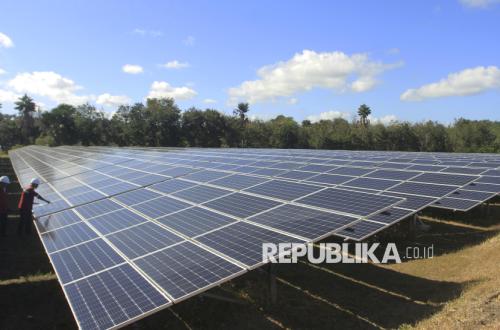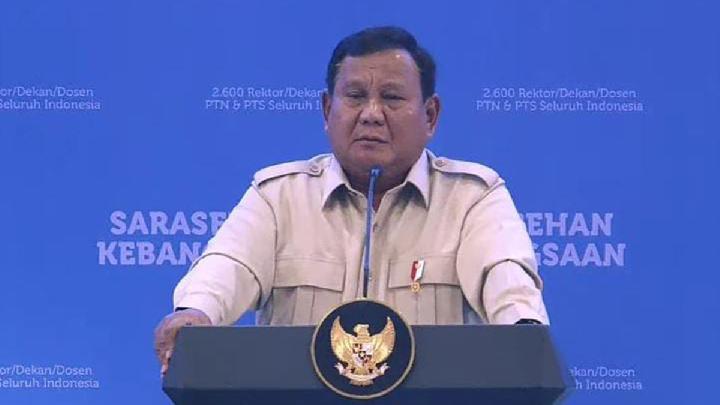
TEMPO.CO, Jakarta - President Prabowo Subianto launched a program to construct solar power plants (PLTS) with a total capacity of 100 gigawatts (GW) in Denpasar, Bali, on Tuesday, August 25, 2026. Prabowo aims to complete the construction in less than three years.
Prabowo stated that the national electricity generation capacity is currently around 88 GW. This capacity comes from power plants that are fueled by coal, oil, and gas, as well as by renewable energy sources, such as geothermal energy.
"Just for your information, currently our total electricity production is at 88 GW, from coal, oil, gas, and geothermal. And we will build 100 GW, and we are serious about it. Our target is 100 GW within three years. Can the Minister of Energy and Mineral Resources (ESDM) do it in three years?" Prabowo said during the program's launch in Bali, as quoted from the live stream on the YouTube channel of the Ministry of ESDM, on Tuesday, August 25, 2026.
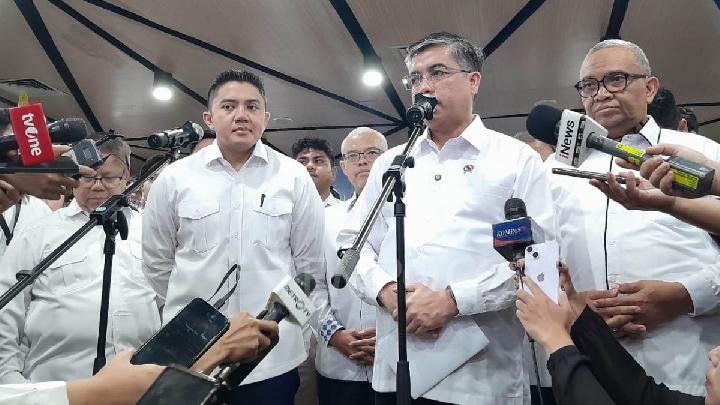
ESDM Minister Bahlil Lahadalia, who attended the event, expressed his readiness to meet the target. Bahlil responded, "Ready," while paying respect to Prabowo.
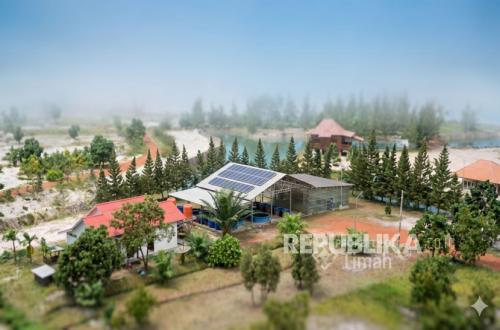
The launch of the 100 GW solar power plants program also took place simultaneously at 14 other locations in Indonesia. According to data from the Ministry of ESDM, the total projects launched in this initial phase reach about 5.2 GWp.
Several projects have entered the construction phase. The 46 MWp Tembesi solar power plant is 65 percent complete, while the 92 MWp Saguling PLTS is 44 percent complete. Construction has also begun on the 133 MWp Karangkates PLTS, which is 56 percent complete.
Other projects are still in the launch, groundbreaking, and tender preparation phases. The Sembur Island PLTS with a capacity of 0.92 MWp and the Rengit PLTS with 0.078 MWp are in the launching phase.
In the groundbreaking phase, there are the Pasuruan PLTS with a capacity of 132 MWp, Banyuwangi 130.2 MWp, and Gajah Mungkur 134.2 MWp. Meanwhile, several other projects are ready to be tendered, including the 300 MWp Gilimanuk PLTS, the 118 MWp Buleleng, the 636 MWp Jatigede, the 69 MWp Purwakarta, the 1,688 MWp Jatiluhur, the 1,250 MWp Cirata, and the 605 MWp Madura.
In his speech, Minister Bahlil Lahadalia mentioned that the construction of the 100 GW solar power plants requires an investment of around US$73 billion or more than Rp1,140 trillion. He stated that the program could save energy subsidies up to Rp73.9 trillion per year. "The project will create approximately 5.52 million job opportunities," said Bahlil.
Bahlil said the construction of solar power plants will be carried out on a large scale over three years. For the projects launched in the initial phase, the estimated cost of solar power plant generation is around 5-6 US cents per kilowatt-hour, excluding battery costs.
"Once we launch this PLTS program, we will carry it out massively, Sir, and divide it over three years. And for the PLTS that we are officially launching now, the cost is approximately around 5 to 6 cents. However, this cost does not include the battery," said Bahlil.
Director of Research and Innovation at the Institute for Essential Services Reform, Raditya Wiranegara, said that the target of building 100 GW of solar power plants face technical challenges and is difficult to achieve in a short time.
"Especially since the domestic solar module production capacity is currently around 14 GW per year," he said.
Therefore, he emphasized the need for a realistic implementation stage to ensure the program remains sustainable without disrupting the system's stability and industrial readiness. With a target of 100 GW within three years, there will be a significant gap between capacity needs and demand.
He mentioned that constructing new factories or arranging imports still requires a lot of time for preparation and logistics. Additionally, Raditya emphasized the importance of Indonesia's electricity infrastructure, which is designed for base-load power plants, such as steam power plants.
He continued that the large-scale integration of solar power plants requires grid modernization, such as the development of smart grids and battery-based energy storage. These are long-term and complex projects.
Human resource readiness is also a challenge. According to Raditya, the large-scale development of solar power plants will absorb hundreds of thousands of workers across the value chain, requiring acceleration in education and professional certification.
Based on IESR's modeling for the 2026-2030 period, a more feasible scenario is to start with around 26 GW in the first four years. This target includes 7.5 GW from utility-scale and captive power projects, as well as 18.4 GW from decentralized programs, such as providing rural areas with electricity and replacing diesel power plants.
He also highlighted the inadequate readiness of the electricity infrastructure. The transmission and distribution networks are not robust enough to handle a significant increase in electricity demand. "Increasing capacity without strengthening the grid could create new problems," he said.
Read: Prabowo Threatens License Revocations for Companies Behind Forest Fires
Click here to get the latest news updates from Tempo on Google News