TEMPO.CO, Jakarta - To all appearances, it really looks as if the United Arab Emirates has picked a side as a result of the US and Israel's war with Iran, a side that could isolate it from much of the rest of the Arab world.
Earlier this week, it was reported that Israel and the UAE were establishing a joint defense fund, which would see the two countries buying weapons together. The report, first published by the media outlet Middle East Eye, cited two unnamed US officials and has not been confirmed by either government.
The fund was apparently agreed to during a secret visit Israeli Prime Minister Benjamin Netanyahu made to the UAE, which he made public on the evening of May 13. A few hours later, the UAE denied the visit ever happened.
The day before, at an event in Tel Aviv, US Ambassador to Israel Mike Huckabee confirmed that Israel had loaned the UAE aerial defense weaponry in order to help defend against air attacks from Iran.
Major regional changes
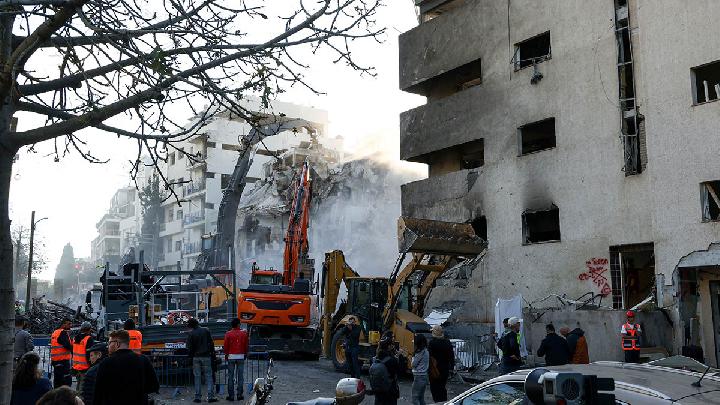
All that—combined with the UAE's late-April announcement that it was leaving the oil producers' syndicate OPEC, to which it had belonged for 59 years—caused a rash of analyses stating that the Middle East was changing radically.
"A decades-old Gulf order is fading, and another is taking shape," Cinzia Bianco, a visiting fellow at the European Council on Foreign Relations, wrote in a mid-May commentary.
"The geopolitical earthquake sparked by the UAE is more than a temporary regional conflict," Ma Young-sam, a former Korean ambassador to Israel, recently said in the English-language daily The Korea Times. "It signals the emergence of a new Middle Eastern order."
Marcus Schneider, who heads the Friedrich Ebert Foundation's regional project for peace and security in the Middle East in Lebanon, described the two emerging blocs like this: One is a hexagon, he said, made up of the UAE and Israel, and the second is a diamond shape, consisting of Saudi Arabia, Pakistan, Turkey and Egypt. The latter countries, which have Sunni-majority populations, have also been called "the Quartet."
Schneider said what connects Israel and the UAE is that both are currently practicing policies of "disruption" to try to "reshape the Middle East and beyond."
Netanyahu has frequently boasted that Israel is "changing the face of the Middle East," something he repeated in early March after Israel's joint attack on Iran with the US. The UAE also "seeks to redraw the map of the Middle East and build new networks of geopolitical and geoeconomic influence centered on Abu Dhabi," Bianco wrote.
But there are also other pragmatic reasons for the partnership. "For the UAE, Israel offers resources, networks, defense capabilities, technological prowess and influence in capitals around the world," Bianco continued.
Meanwhile, the so-called Sunni "diamond" is pursuing a different kind of policy, Schneider told DW. Although the Saudis have been responsible for their fair share of disruption in the past, more recently their behavior has changed because they need stability in order to achieve their economic objectives.
"It's a more transactional approach," Schneider said of the grouping of four nations. "As in, 'we have a common interest in engaging Iran because we are the ones who suffer' and 'we also have an interest in Israel, because of this Israeli thinking that they can somehow bomb everything, everywhere, all the time, and we basically want to bring that into consideration too.'"
Saudi Arabia's growing concerns about Israel were outlined in a May op-ed by Prince Turki al-Faisal, a former head of the Saudi intelligence agency, in the London-based newspaper Asharq Al-Awsat. The commentary was characterized as representing the Saudi government's point of view.
"Had the Israeli plan to ignite war between us and Iran succeeded, the region would have been plunged into ruin and destruction," al-Faisal wrote. "Thousands of our sons and daughters would have been lost in a battle in which we had no stake. Israel would have succeeded in imposing its will on the region and remained the only actor in our surroundings."
Picking a side
Even before the UAE's moves this month and before the Iran war, there had been a rift in the Gulf, as evidenced by disagreements between the UAE and Saudi Arabia over Yemen.
"Regional developments … have really illustrated the difference in visions of regional order," Kristian Coates Ulrichsen, a Middle East fellow at Rice University's Baker Institute for Public Policy in Texas, US, told DW earlier this year. "There is no appetite in Saudi Arabia for renewed military adventurism, unlike the perceived appetite that Abu Dhabi has for risk-taking and backing armed non-state regional groups."
When the Iran war began, the Gulf states seemed to paper over those differences in favor of unity. But now, with one country deepening cooperation with Israel and the other calling it as a growing threat, divisions have reemerged. "The Saudis and the Emiratis are basically moving in opposite directions," Schneider confirmed.
However, analysts also say that the idea that the UAE or Saudi Arabia have "picked a side" is the wrong way to look at these changes. This isn't about unresolvable ideological differences, such as those seen during the Cold War. The Saudis and Emiratis are still working together in other areas, despite recent changes.
"We are in an era of what's being called geopolitical promiscuity," Schneider explained. "And these are not rigid alliances."
"The alignments we see in the Gulf do not reflect a calculated, permanent grand strategy," Ibrahim Öztürk, a professor of economic development at the University of Duisburg-Essen in central Germany, told DW. "Rather than picking sides, these states are in a frantic scramble to navigate a highly volatile environment."
Could one side dominate?
"If we analyze the region solely through the lens of short-term military escalation, the US-backed Israeli axis appears dominant," Öztürk said. But, he added, these are superficial, temporary alliances that will eventually be overwhelmed by circumstances.
Consider the Sunni quartet, he said: "Sustaining this coalition is historically, religiously, structurally and economically impossible," he argued. "These nations possess vastly different regime types, internal vulnerabilities and divergent dependencies on global superpowers such as China and the US."
And the UAE-Israel alliance also has flaws. "[It] is formidable in financial, intelligence and technological terms," Rachel Bronson, a senior non-resident fellow at the Chicago Council on Global Affairs, wrote in a May analysis. "But they are two small states facing heavy counterweights. Turkey is a NATO member with a large military; Pakistan is a nuclear power; and Saudi Arabia holds the world's largest proven oil reserves and speaks for the holy sites of Mecca and Medina. The UAE's sovereign wealth, north of $1 trillion, is a genuine force multiplier. But wealth is not the same as strategic depth."
Schneider also thinks there are internal contradictions in the UAE that might disrupt the partnership with Israel.
"I have the feeling that they want to be two things at the same time," he said of Abu Dhabi and Dubai, the two largest of the seven emirates that make up the UAE.
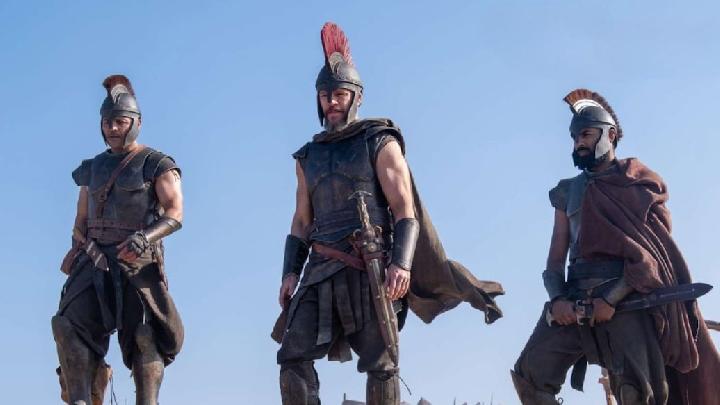
"Abu Dhabi wants to be a kind of Sparta — so, like the ancient Greek state, very militaristic, highly belligerent," he explained. "Meanwhile, Dubai wants to be more like Switzerland: an island of stability where airlines can land, influencers live and Iran does its banking. But you can't really be both at the same time."
Read: Netanyahu's 'Secret Visit' Sparks Tension With UAE
Click here to get the latest news updates from Tempo on Google News